Jack Kerouac Art State Line of Colorado and Utah
| Neal Cassady | |
|---|---|
 | |
| Born | Neal Leon Cassady (1926-02-08)February 8, 1926 Table salt Lake City, Utah, U.Southward. |
| Died | Feb four, 1968(1968-02-04) (aged 41) San Miguel de Allende, Mexico |
| Occupation | Author, poet |
| Genre | Beat poetry |
| Literary movement | Shell |
| Notable works | The First Third |
| Spouse | LuAnne Henderson (1945–1948; annulled), Carolyn Cassady (1948–1963; divorced),[ane] |
| Partner | Diane Hansen (1950–?), Anne Murphy (?–1968) |
| Children | 5 [ii] |
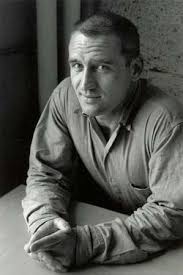
Neal Leon Cassady (February 8, 1926 – February 4, 1968) was a major effigy of the Trounce Generation of the 1950s and the psychedelic and counterculture movements of the 1960s.
He was prominently featured as himself in the "scroll" (first draft) version of Jack Kerouac's novel On the Road, and served equally the model for the character Dean Moriarty in the 1957 version of that volume. In many of Kerouac's later books, Cassady is represented by the grapheme Cody Pomeray. Cassady also appeared in Allen Ginsberg'southward poems, and in several other works of literature by other writers.
Biography [edit]
Early years [edit]
Cassady was born to Maude Jean (Scheuer) and Neal Marshall Cassady in Table salt Lake City, Utah.[3] His mother died when he was 10, and he was raised by his alcoholic father in Denver, Colorado. Cassady spent much of his youth either living on the streets of skid row, with his male parent, or in reform school.
As a youth, Cassady was repeatedly involved in niggling offense. He was arrested for auto theft when he was fourteen, for shoplifting and car theft when he was xv, and for car theft and fencing stolen property when he was xvi.
In 1941, the 15-year-old Cassady met Justin W. Brierly, a prominent Denver educator.[four] Brierly was well known as a mentor of promising young men and was impressed past Cassady'south intelligence. Over the adjacent few years, Brierly took an active office in Cassady's life. Brierly helped admit Cassady to East Loftier School where he taught Cassady as a student, encouraged and supervised his reading, and found employment for him. Cassady continued his criminal activities, however, and was repeatedly arrested from 1942 to 1944; on at to the lowest degree one of these occasions, he was released by law enforcement into Brierly's safekeeping. In June 1944, Cassady was arrested for possession of stolen goods and served 11 months of a one-twelvemonth prison sentence. Brierly and he actively exchanged letters during this period, even through Cassady's intermittent incarcerations; this correspondence represents Cassady's primeval surviving letters.[v] Brierly is also believed to have been responsible for Cassady's first homosexual experience.[six] [ verify ]
Personal life [edit]

In October 1945, after being released from prison house, Cassady married 16-year-old Lu Anne Henderson.[seven] In 1946, the couple traveled to New York Urban center to visit their friend, Hal Hunt, another protégé of Brierly's. While visiting Chase at Columbia University, Cassady met Jack Kerouac and Allen Ginsberg.[8] Although Cassady did non nourish Columbia, he soon became friends with them and their acquaintances, some of whom later became members of the Beat Generation. While in New York, Cassady persuaded Kerouac to teach him to write fiction. Cassady's second wife, Carolyn, has stated, "Neal, having been raised in the slums of Denver amidst the globe'due south lost men, adamant to make more than of himself, to go somebody, to be worthy and respected. His genius mind absorbed every book he could observe, whether literature, philosophy, or scientific discipline. Jack had a formal education, which Neal envied, merely intellectually he was more than a match for Jack, and they enjoyed long discussions on every subject."[9]
Carolyn Robinson met Cassady in 1947, while she was studying for her primary'due south in theater arts at the Academy of Denver.[x] V weeks afterwards Lu Anne'southward departure, Neal got an disparateness from Lu Anne and married Carolyn, on April 1, 1948. Carolyn'south book, Off the Road: Twenty Years with Cassady, Kerouac and Ginsberg (1990), details her spousal relationship to Cassady and recalls him every bit "the archetype of the American Man".[11] Cassady'south sexual relationship with Ginsberg lasted off and on for the side by side 20 years.[12]
During this menses, Cassady worked for the Southern Pacific Railroad and kept in touch with his "Trounce" acquaintances, even equally they became increasingly different philosophically.
The couple eventually had three children and settled down in a ranch house in Monte Sereno, California, 50 miles south of San Francisco, where Kerouac and Ginsberg sometimes visited.[13] This abode, congenital in 1954 with money from a settlement from Southern Pacific Railroad for a train-related accident, was demolished in August 1997.[xiv] In 1950, Cassady entered into a marriage with Diane Hansen, a young model who was pregnant with his child, Curtis Hansen.[15]
Cassady traveled cross-country with both Kerouac and Ginsberg on multiple occasions, including the trips documented in Kerouac's On the Road.
Role of drugs [edit]
Following an arrest in 1958 for offering to share a small corporeality of marijuana with an undercover agent at a San Francisco nightclub, Cassady served a two-year sentence at California's San Quentin State Prison in Marin County. After his release in June 1960, he struggled to meet family unit obligations, and Carolyn divorced him when his parole menses expired in 1963. Carolyn stated that she was looking to salvage Cassady of the burden of supporting a family unit, but "this was a mistake and removed the last pillar of his cocky-esteem".[xvi]
After the divorce, in 1963, Cassady shared an apartment with Allen Ginsberg and Shell poet Charles Plymell, at 1403 Gough Street, San Francisco.[ citation needed ]
Cassady first met author Ken Kesey during the summertime of 1962; he somewhen became one of the Merry Pranksters, a group that formed around Kesey in 1964, who were song proponents of the utilise of psychedelic drugs.[ citation needed ]
Travels and death [edit]
During 1964, Cassady served equally the master commuter of the omnibus named Furthur on the iconic first half of the journeying from San Francisco to New York, which was immortalized by Tom Wolfe'due south book, The Electric Kool-Aid Acid Test (1968). Cassady appears at length in a documentary pic about the Merry Pranksters and their cross-state trip, Magic Trip (2011), directed past Alex Gibney.
In January 1967, Cassady traveled to Mexico with beau prankster George "Barely Visible" Walker and Cassady's longtime girlfriend Anne Murphy. In a beachside house just due south of Puerto Vallarta, Jalisco, they were joined by Barbara Wilson and Walter Cox. All-dark storytelling, speed drives in Walker'south Lotus Elan, and the use of LSD made for a classic Cassady operation — "like a trained acquit," Carolyn Cassady in one case said. Cassady was beloved for his ability to inspire others to love life, yet at rare times he was known to limited regret over his wild life, particularly as it affected his family. At ane point, Cassady took Cox, then xix, aside and told him: "[T]wenty years of fast living — there'southward only not much left, and my kids are all screwed upwardly. Don't do what I have done."[ commendation needed ]
During the next year, Cassady'south life became less stable, and the footstep of his travels more than frenetic. He left United mexican states in May, traveling to San Francisco, Denver, New York Urban center, and points in betwixt. Cassady and so returned to Mexico in September and October (stopping in San Antonio, on the way to visit his oldest girl, who had just given birth to his beginning grandchild), visited Ken Kesey's Oregon subcontract in December, and spent the New Year with Carolyn at a friend's firm near San Francisco. Finally, in late January 1968, Cassady returned to Mexico once again.
On February 3, 1968, Cassady attended a wedding ceremony party in San Miguel de Allende, Guanajuato, Mexico. After the party, he went walking along a railroad track to reach the adjacent boondocks, merely passed out in the cold and rainy dark wearing nothing but a T-shirt and jeans. In the morning, he was institute in a coma by the tracks, reportedly by Anton Black, after a professor at El Paso Customs College, who carried Cassady over his shoulders to the local post office edifice. Cassady was and then transported to the closest hospital, where he died a few hours after on February 4, iv days brusque of his 42nd birthday.
The exact cause of Cassady's death remains uncertain. Those who attended the wedding ceremony party ostend that he took an unknown quantity of secobarbital, a powerful barbiturate sold nether the brand name Seconal. The physician who performed the dissection wrote only, "general congestion in all systems." When interviewed later, the physician stated that he was unable to give an accurate report because Cassady was a foreigner and there were drugs involved. "Exposure" is ordinarily cited as his cause of expiry, although his widow believes he may have died of kidney failure.[17]
Children [edit]
Cassady has v known children: Robert William Hyatt Jr. (1945), Cathleen Joanne Cassady (1948), Jami Cassady Ratto (1949), Curtis W. Hansen (1950), and John Allen Cassady (1951). Robert, son of Neal Cassady and Maxine Beam, is an creative person working in Arvada, Colorado. In February 2017, he was featured in Westword mag.[18] Cathleen, known equally Cathy, is the mother of the only grandchild Neal met. Cathy, Jami, and John continue a website in retentivity of their parents and parents' "beat" friends.[19] [20]
Curt, born from a bigamous marriage with Diana Hansen, died April 30, 2014, aged 63. He was one of the co-founders of radio station WEBE 108, in Bridgeport, Connecticut.[21]
Writing style and influence [edit]
Cassady is credited with helping Kerouac break with his Thomas Wolfe-influenced sentimental manner, equally seen in The Town and the Metropolis (1950). After reading Cassady'southward messages, Kerouac was inspired to write his story in Cassady's communication manner: "...in a blitz of mad ecstasy, without self-consciousness or mental hesitation".[22]
This fluid writing manner, reading more than like a stream of consciousness or hypermanic rapid-burn conversation than written prose, is best demonstrated within Cassady'due south messages to family and friends. In a letter of the alphabet to Kerouac from 1953, Cassady begins with the following fervent sentence;
Well it's about time you wrote, I was fearing you farted out on top that mean mount or slid under while pissing in Pismo, embankment of flowers, food and foolishness, but I knew the fear was ill-founded for balancing it in my thoughts of you, much stronger and valid if you lot weren't dead, was a realization of the experiences yous would be having down there, runway, home, and the most important, climate, past a remembrance of my ain feelings and thoughts (old depression, or more exactly, nostalgic and unreal; latter hi) as, for case, I too seemed to spend time looking out upper floor windows at sparse, especially nighttime times, traffic in females—old or young.[23]
On the Road became a sensation. By capturing Cassady'due south vox, Kerouac discovered a unique way of his own that he called "spontaneous prose," a stream of consciousness prose form.[24]
Cassady's own written work was never formally published in his lifetime, and he left behind only a one-half-written manuscript and a number of personal letters. Cassady admitted to Kerouac in a letter from 1948, "My prose has no individual style as such, only is rather an unspoken and withal unexpressed groping toward the personal. At that place is something there that wants to come out; something of my ain that must exist said. Yet, perhaps, words are not the way for me."[23]
Appearances and influence in popular culture [edit]
In film [edit]
Archival footage [edit]
- Canticle to Beauty (1997).
- Love Always, Carolyn — A film about Kerouac, Cassady and Me (2011), a documentary that features Cassady in archival segments, likewise equally interviews with Cassady's ex-wife Carolyn and his children.[25]
- Magic Trip (2011), Alex Gibney's documentary film using the footage shot by Ken Kesey and the Merry Pranksters during their cross-state bus trip in the Furthur bus; the hyperkinetic Cassady is frequently seen driving the bus, jabbering, and sitting next to a sign that boasts, "Neal gets things done."
- The Other Ane: The Long Strange Trip of Bob Weir (2015).
Dramatizations [edit]
- The picture show Who'll Finish the Pelting (1978) is a psychological drama released by United Artists. The film is based on Robert Stone's novel Dog Soldiers (1974), and stars Nick Nolte every bit Ray Hicks. Stone based the character of Hicks on Beat writer Neal Cassady. Stone became acquainted with Cassady through novelist Ken Kesey, a classmate of Stone in graduate school at Stanford Academy. Hicks' death scene on the railroad tracks at the film'due south conclusion was straight based on Cassady's death forth a railroad runway outside of San Miguel de Allende, Mexico, in 1968.
- Heart Beat (1980), which portrays Neal Cassady's friendship with Jack Kerouac, stars Nick Nolte as Cassady and John Heard as Kerouac. The film was based on the memoir of the same name by Carolyn Cassady (played by Sissy Spacek). Talk evidence host Steve Allen, who was a big supporter of On The Road, appears briefly as himself. Released immediately later Warner Bros. acquired Orion Pictures, the film was given a express release due to studio politics and a perceived lack of public involvement. The flick rapidly fell from view.
- What Happened to Kerouac (1986).
- The Terminal Fourth dimension I Committed Suicide (1997), with Thomas Jane as Cassady, is based on the "Joan Anderson letter of the alphabet" written past Cassady to Jack Kerouac in December 1950. Until 2014, much of this letter was thought to have been lost, though an excerpt had been published in a 1964 edition of John Bryan's magazine Notes from Underground.
- A brusque film Luz Del Mundo (2007) deals with Cassady's friendship and adventures with Jack Kerouac. Cassady is played past Austin Nichols, and Kerouac is played by Will Estes.[26]
- In the film Across the Universe (2007), the grapheme Dr. Robert, played past Bono, is said to accept been inspired past Neal Cassady.[27]
- Neal Cassady (2007), a biographical film [28] focused mostly on the Merry Prankster years and stars Tate Donovan equally Neal, Amy Ryan as Carolyn Cassady, Chris Bauer every bit Kesey, and Glenn Fitzgerald as Kerouac; Noah Buschel wrote and directed the motion picture, which deals primarily with how Neal became trapped by his fictional alter-ego, Dean Moriarty. The Cassady family criticized this film as highly inaccurate.[29]
- Howl (2010), Jon Prescott, chronicles Allen Ginsberg's creation of the poem "Howl" and the obscenity trial surrounding its publication; Jon Prescott portrays Cassady.[30] [31]
- In On the Road (2012), the dramatic adaptation of the book, Neal Cassady/Dean Moriarty is portrayed by Garrett Hedlund.[32]
- In Big Sur (2013), Josh Lucas portrays Cassady.
In literature [edit]
- David Amram's OFFBEAT: Collaborating with Kerouac (2002)
- Charles Bukowski's Notes of a Muddied Old Human (1969) as "Kerouac's boy Neal C."
- Allen Ginsberg:
- "The Greenish Automobile" (1953) as "my quondam companion"
- "Howl" (1956) as "Northward.C., secret hero of these poems"
- "Many Loves" (1956)
- "On Neal's Ashes" (1968)
- "The Autumn of America" (1968)
- "Elegies for Neal Cassady" (1968)
- John Clellon Holmes:
- Get (1952) as "Hart Kennedy"
- The Horn (1958) equally "the driver"
- Jack Kerouac:
- On the Road (1957) as "Dean Moriarty". Cassady was the model for the character Dean Moriarty in Kerouac's On the Road, and the graphic symbol "Cody Pomeray" in many of Kerouac'southward other novels. In the surviving commencement draft of On the Route, which Kerouac typed on a 120-foot roll of paper specially constructed for that purpose, the story's protagonist'southward proper name remains "Neal Cassady".[33] Nevertheless, in Kerouac's concluding edition of On The Road, Cassady's grapheme is known as "Dean Moriarty". In On the Road, the narrator, Sal Paradise (representing Jack Kerouac) states, "He was simply a youth tremendously excited with life, and though he was a con-homo, he was only conning considering he wanted and then much to live and to get involved with people who would otherwise pay no attention to him ... Somewhere forth the line, I knew there'd be girls, visions, everything; somewhere along the line, the pearl would be handed to me."[34] [35]
- The Subterraneans (1958) every bit "Leroy"
- The Dharma Bums (1958) as "Cody"
- Volume of Dreams (1960) as "Cody Pomeray"
- Visions of Cody (1960; published 1973) as "Cody Pomeray"
- Big Sur (1962) as "Cody Pomeray"
- Desolation Angels (novel) (1965) as "Cody Pomeray"
- Ken Kesey:
- "Over the Border" (1973), as "Houlihan"
- Kesey also wrote a fictional account of Cassady's death in the short story "The Day Subsequently Superman Died" (1979, referring to Cassady as "Houlihan"), wherein Cassady is portrayed as mumbling most the number of railroad ties he had counted on the line (64,928) as his last words before dying. It was published as a part of Kesey's drove Demon Box (1986).
- I of the interviewees[ who? ] in the film Magic Trip (2011) states that Cassady was the inspiration for the main character (who was the master character?)of Ken Kesey'due south novel One Flew Over the Cuckoo's Nest (1962).
- Phil Lesh'southward Searching for the Audio: My Life with the Grateful Dead (2005)
- Nick Mamatas' Move Under Ground (2004)
- Chuck Rosenthal's Jack Kerouac's Avatar Affections: His Last Novel (2001), equally "Cody Pomeray."
- Robert Stone:
- "Porque No Tiene, Porque Le Falta" (1969), as "Willie Wings"
- Dog Soldiers (1974), equally "Ray Hicks"
- Prime Green: Remembering the Sixties (2007)
- In Hunter S. Thompson's book Hell'south Angels (1966), Cassady is described as, "the worldly inspiration for the protagonist of two recent novels", drunkenly yelling at police force during the famed Hells Angels parties at Ken Kesey'southward residence in La Honda, California. Although Cassady's name was removed from the book at the insistence of Thompson'southward publisher, the description is conspicuously a reference to the grapheme based on Cassady in Jack Kerouac's works, On the Road and Visions of Cody (1951–1952).
- Tom Wolfe besides chronicled Cassady's drunken yelling at police force during Hells Angels parties in The Electric Kool-Aid Acrid Test (1968).
In music [edit]
- Tom Waits recorded "Jack & Neal /California, Hither I Come," on his 1977 album Foreign Affairs.
- A New York Urban center-based folk duo, Aztec Ii Step, in their 1972 debut album memorialized Cassady in the song "The Persecution & Restoration of Dean Moriarty (On The Road)".
- Expiry Cab for Cutie loosely based their song "Styrofoam Plates" from The Photograph Album (2001) on the events of Cassady'due south life depicted in On the Road.
- The Doobie Brothers guitarist and songwriter Patrick Simmons refers to Cassady in his song "Neal's Fandango" as his incentive for taking to the road.
- Cassady lived briefly with The Grateful Dead and is immortalized in "The Other One" section of their song "That's It For The Other One", as the coach driver "Cowboy Neal".[36] [37]
- A second Grateful Dead vocal, "Cassidy" by John Perry Barlow, might seem to exist a misspelling of Cassady's name. Even so, in fact, the song primarily celebrates the 1970 nativity of baby girl Cassidy Police force into the Grateful Dead family unit, though the lyrics also include references to Neal Cassady himself.[38]
- Bocephus King sings a song called "Cowboy Neal".
- The progressive rock ring King Ruby released a song named "Neal and Jack and Me" on their anthology Beat (1982).
- Morrissey's album World Peace Is None of Your Concern (2014) features a track called "Neal Cassady Drops Expressionless".
- The Franco-American band Moriarty is named after the fictional character Dean Moriarty that Kerouac created from Neal Cassady.
- Jazz guitarist John Scofield wrote a song called "Cassidae" [sic], released on his album Who'due south who? (1979).
- Singer-songwriter Eric Taylor's song "Dean Moriarty" (1995) describes a character patterned after Neal Cassady.
- Fatboy Slim produced a track, "Neal Cassady Starts Here", that appeared as a B-side to the singles "Santa Cruz" and "Everybody Needs A 303" (1996).
- The Beat-inspired folk revival ring Washington Squares released a song named "Neal Cassady" on their album Fair and Foursquare (1989).
Published works [edit]
- "The Joan Anderson Letter of the alphabet", written past Cassady to Jack Kerouac (December, 1950): information technology was, until 2014, idea to have been lost, though an extract had been published in a 1964 edition of John Bryan'southward magazine Notes from Underground.[39] Associated Press reported in Nov 24, 2014, that the unabridged letter had been institute. The 18-page letter, which is said to have substantially inspired Kerouac's subsequent writing style, was to be auctioned on December 17, 2014, but a legal dispute over ownership prevented the sale from proceeding.[xl] [41] The original letter was auctioned past Heritage Auctions as Lot 45378 on March eight, 2017.[42] [43] [44]
- "Pull My Daisy" (1951, poetry) written with Jack Kerouac and Allen Ginsberg.
- "Genesis West: Volume Seven" (1965, magazine article) [45]
- "Offset Night of the Tapes" with Jack Kerouac. "Transatlantic Review" December, 1969.
- The Outset Third (1971, autobiographical novel), published iii years after Cassady's death.
- Grace Beats Karma: Letters from Prison (collection of poetry and messages). New York, NY: Blast Books, 1993. ISBN 0-922233-08-X
- Neal Cassady: Collected Letters, 1944–1967 (2004, messages).
Published biographies [edit]
- The Holy Goof: A Biography of Neal Cassady, by William Plummer (1981)
- Neal Cassady, Volume 1, 1926–1940, past Tom Christopher (1995)
- Neal Cassady, Volume Two, 1941–1946, by Tom Christopher (1998)
- Neal Cassady: The Fast Life of a Beat Hero, by David Sandison & Graham Vickers (2006)
- Off the Road: Twenty Years with Cassady, Kerouac, and Ginsberg, by Carolyn Cassady. Black Jump Press (1990).
Literary studies [edit]
- Stephenson, Gregory (2007) [1987]. "Friendly and Flowing Fell: The Literary Legend of Neal Cassady". Incorporated in The Daybreak Boys: Essays on the Literature of the Trounce Generation (1990).
References [edit]
Notes [edit]
- ^ Cochrane, Lauren (2011-01-18). "Neal Cassady: Drug-taker. Bigamist. Family human". The Guardian . Retrieved 2017-07-19 .
- ^ Daurer, Gregory (2017-02-07). "Neal Cassady'due south Denver Legacy Includes a Secret Son, Robert Hyatt". Westword.com . Retrieved 2018-04-14 .
- ^ Sandison, David; Vickers, Graham (2006-11-nineteen). "Neal Cassady". The New York Times . Retrieved 2010-05-20 .
- ^ Cassady & Moore 2004, p. 1.
- ^ Cassady & Moore 2004, p. one; Sandison & Vickers 2006, pp. 42–46.
- ^ Turner 1996, p. 79:[ verify ] "Brierly had been sexually attracted to Neal, and managed to entice him into his outset homosexual feel." Sandison & Vickers 2006, pp. 41–42:[ verify ] "Brierly was most likely also a closet homosexual, and it was probably through him that Neal Cassady would first discover and explore gay sex and serve as a hustler in Denver's gay community." Co-ordinate to some reports, still, Brierly's sexual orientation was an open secret; meet Weir, John (2005-06-22), "Everybody knows, nobody cares, or: Neal Cassady's Penis", TriQuarterly, archived from the original on 2009-06-20 .
- ^ "RootsWeb: OBITUARIES-L [OBITS] Neal Cassady".
- ^ Asher, Levi. "Neal Cassady". beatmuseum.org. Literary Kicks. Retrieved v Nov 2014.
- ^ "Neal Cassady Carolyn Cassady Frequently Asked Questions".
- ^ Campbell, James (2013-09-23). "Carolyn Cassady obituary". The Guardian. ISSN 0261-3077. Retrieved 2017-07-20 .
- ^ Ferlinghetti, Lawrence (1990). Off the Road: My Years with Cassady, Kerouac and Ginsberg. Nation. pp. 652–653.
- ^ Young, Allen (1973). Allen Ginsberg: the Gay Sunshine Interview. Bolinas, California: Grey Fox Press. p. one.
- ^ Cassady, Carolyn (1990). Off the Road: My Years with Cassady, Kerouac, and Ginsberg. London: Black Jump Press. ISBN0-948238-05-4.
- ^ "Metroactive Features – Neal Cassady'southward House".
- ^ Cochrane, Lauren (2011-01-18). "Neal Cassady: Drug-taker. Bigamist. Family homo". The Guardian. ISSN 0261-3077. Retrieved 2017-07-twenty .
- ^ "Carolyn Cassady". Neal Cassady Estate.
- ^ Neal Cassidy website (retrieved 26 January 2009)
- ^ Daurer, Gregory (7 February 2017). "Neal Cassady'southward Denver Legacy Includes a Secret Son, Robert Hyatt". Retrieved 8 November 2018.
- ^ "The legacy of iconic literary figure Neal Cassady lives on in Santa Cruz with his son and girl". Retrieved June 27, 2014.
- ^ "Cassady Family's Website". Neal Cassady Estate . Retrieved June 27, 2014.
- ^ "Curtis Hansen Obituary". Milford Mirror . Retrieved June 27, 2014.
- ^ Asher, Levi (24 July 1994). "Neal Cassady". LitKicks.come. Literary Kicks. Retrieved 5 November 2014.
- ^ a b "Neal Cassady: American Muse, Holy Fool". New Yorker.
- ^ Knight, Arthur and Kit (1988). Kerouac and the Beats . New York, NY: Paragon House. ISBN1-55778-067-6.
- ^ "Love Always, Carolyn". Documentary film. IMDB. Retrieved 9 September 2011.
- ^ "Luz del mundo". 1 Jan 2000 – via IMDb.
- ^ Inc, Slacker. "AOL Radio Stations". Archived from the original on 2016-03-25. Retrieved 2017-01-19 .
- ^ "Neal Cassady". 11 October 2007 – via IMDb.
- ^ http://www.nealcassadyestate.com/carolyn.html, retrieved 28 August 2007
- ^ Brooks, Barnes (Dec two, 2009). "Sundance Tries to Hone Its Artsy Edge". newyorktimes.com.
- ^ "Alessandro Nivola is hotter than Audrey Tautou". BlackBookMag.com. 22 September 2009. Retrieved 2009-09-22 .
- ^ "On the Road". 23 May 2012 – via IMDb.
- ^ Paul Maher Jr. Kerouac: The Definitive Biography (Lanham, Dr.: Taylor Trade Publishing, 2004) p. 233 ISBN 0-87833-305-three
- ^ Kerouac, Jack (1976). On The Road. USA: Penguin Group. ISBN1-101-12757-0.
- ^ Bignell, Paul; Johnson, Andrew (2007-07-29). "On the Road (uncensored). Discovered: Kerouac 'cuts'". The Independent. London. Archived from the original on 2007-09-27. Retrieved 2010-05-20 .
- ^ "Other One". Dead.cyberspace . Retrieved Baronial 4, 2007.
- ^ http://arts.ucsc.edu/GDead/AGDL/other1.html Archived 2008-05-fourteen at the Wayback Machine, retrieved 23 August 2007
- ^ "Cassidy's Tale". 3 Nov 1994. Retrieved 8 November 2018.
- ^ Sandison & Vickers 2006, pp. 282
- ^ "Kerouac letter of the alphabet discovery shows poet didn't toss it". Boston Herald. November 24, 2014.
- ^ Neary, Lynne (November 24, 2014). "Long lost letter of the alphabet that inspired On the Route Way has been establish". National Public Radio.
- ^ "2017 March 8 Heritage Rare Volume Sale #6174". Heritage Auctions. February 2017.
- ^ "Update/News of the Joan Anderson Letter". March ix, 2017.
- ^ Schuessler, Jennifer (September 27, 2017). "Long-Lost Letter of the alphabet to Jack Kerouac Reaches Its Final Destination". The New York Times.
- ^ Cassady, Neal. "Genesis West Mag". Abebooks . Retrieved 18 September 2018.
Bibliography [edit]
- Cassady, Neal; Moore, Dave (2004), Neal Cassady: Collected Letters, 1944–1967, Penguin Books, ISBN978-0-14-200217-9
- Collins, Ronald & Skover, David (March 2013). Mania: The Story of the Outraged & Outrageous Lives that Launched a Cultural Revolution. Elevation-5 Books.
{{cite book}}: CS1 maint: uses authors parameter (link) - Sandison, David; Vickers, Graham (2006), Neal Cassady: The Fast Life of a Beat Hero , Chicago Review Press, ISBN1-55652-615-half-dozen .
- Turner, Steve (1996), Angelheaded Hipster: A Life of Jack Kerouac, London: Bloomsbury Publishing Plc, ISBN0-7475-2480-7
Further reading [edit]
Archival resources [edit]
- Allen Ginsberg film and video archive, 1983–1996 (154 videotapes) are housed at the Stanford University Libraries
- Allen Ginsberg papers, 1937–1994 (circa k linear feet) are housed at the Stanford University Libraries
- Allen Ginsberg papers, 1944–1991 (x linear feet) are housed at the Columbia Academy Library
- Jack Kerouac Papers, 1920–1977 (bulk 1935–1969) (22.v linear feet) are housed at the New York Public Library
- Neal Cassady Collection, 1947–1965 (.83 linear feet) are housed at the Harry Bribe Center at the University of Texas at Austin
- Finding assistance to Shell poets and poetry collection at Columbia University. Rare Book & Manuscript Library.
External links [edit]
- Neal Cassady Official site of Neal Cassady'southward manor, with stories and photos contributed by the family unit; Carolyn Cassady, Cathy Cassady Sylvia, Jami Cassady Ratto and John Allen Cassady
- Photos, Neal Cassady Sr. Gravesite
- Denver Colorado, Neal Cassady, and the Beat Generation
- Neal'south Denver at Literary Kicks
- Neal Cassady at Literary Kicks
- Cassady Pages at Art and Leisure
- Neal Cassady at rotten.com
- Neal Cassady at IntrepidTrips.com
- The Last Fourth dimension I Committed Suicide at IMDb
- Heart Beat out at IMDb
- Kerouac Alley – Neal Cassady directory
- Denver Beat out Photo Tour, Cassady Haunts and Homes, More
- A gallery of Neal Cassady and related volume covers
- Neal Cassady at Find a Grave
- Victoria Mixon'due south Interviews with Carolyn Cassady
- Bono Plays Doctor in 'Across the Universe'
- Neal Cassady: The Denver Years
rodriguezcoughteeir.blogspot.com
Source: https://en.wikipedia.org/wiki/Neal_Cassady

Post a Comment for "Jack Kerouac Art State Line of Colorado and Utah"